


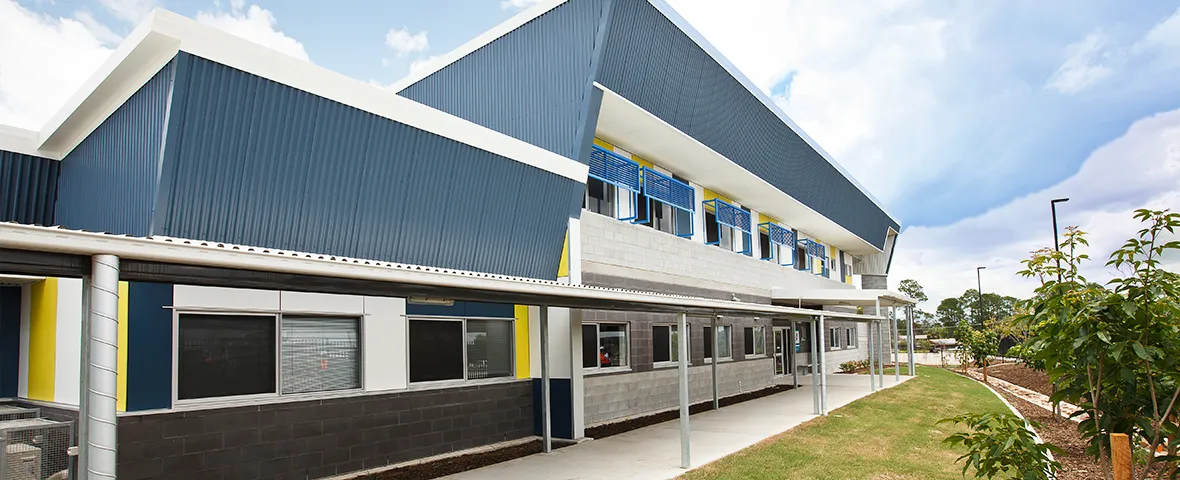


The Queensland Schools Project stands as a model for successful public-private partnerships (P3) in education. It was established through collaboration between the Plenary Schools consortium and the Queensland Government’s Department of Education to meet growing demand in South East Queensland. The project also improved regional economic activity during construction, with around 1,700 local construction and supply chains jobs generated each year. The vast majority of the trades used on site were local companies, providing a boost to southeast Queensland’s economy.
All ten schools include energy-efficiency measure that deliver comfortable learning and teaching environments. For example, making the best use of indoor and outdoor spaces by achieving efficiencies in natural light, shade, glare and temperature.
Over a concession period of 30 years, Plenary will manage ten schools, built to accommodate 10,000 students, by integrating innovative software solutions and optimized asset management approaches. Service Works Global’s (SWG) QFM P3rform software plays a central role in supporting operational efficiency and asset longevity.
Project overview
The project began in 2013 with a phased construction and commissioning process. Facilities came online progressively, requiring a coordinated effort to keep track of new buildings, assets, and systems. This brought about logistical complexities: each school needed rapid integration into a single system for facility management, while meeting high standards for compliance, safety, and accessibility.
Plenary selected QFM P3rform to centralize data, FM processes and manage P3 performance from the start. The initial challenge was adapting QFM’s asset tracking and compliance capabilities to handle phased asset introductions and ensure all schools met regulatory requirements. QFM was configured to provide custom reports and visual dashboards, streamlining the job-logging process for school staff while enabling Plenary to oversee all facilities activities across locations.
Rogier Waalder, senior asset manager at Plenary Schools, has worked on the project from the beginning and was one of the first users of the software. “Queensland Schools is the first P3 I’ve worked on. QFM helped manage the scale and expectations of this important project.”
The support that QFM has provided can be broadly categorised into six key areas.
1. Asset lifecycle management and replacement planning
After a decade of operation, asset lifecycle management is now a priority. The Queensland Schools Project will soon enter its first major replacement phase, focusing on essential equipment such as HVAC units and other high-use assets. With QFM’s comprehensive asset register and lifecycle tools, Plenary can accurately monitor the lifespan, service history, and performance of each asset. Data-driven insights from QFM allow Plenary to schedule replacements based on actual wear and performance, preventing unnecessary expenditures while minimising disruptions.
Waalder notes: “Everything’s got to be data driven. I can’t just make a decision based on my gut feel. Having all the information in one spot makes my life easier. I don’t have to go to all these different places for data.”
QFM’s reporting capabilities enable Plenary to examine the condition of specific assets, such as evaluating the number of reactive maintenance requests on an ageing air-conditioning unit. This data helps Plenary decide whether to replace an asset or extend its life. By automating this complex analysis, QFM supports cost-effective decision-making and helps maintain optimal conditions for learning environments.
2. Contractor management and compliance
Effective contractor management is essential in a P3 structure. Each school has a facilities team, provided by Delta FM, responsible for day-to-day maintenance, service requests, and ensuring compliance with performance metrics. Plenary oversees contractor performance with QFM, ensuring Delta FM meets stringent key performance indicators (KPIs) and service level agreements (SLAs) at every site.
Plenary’s use of QFM’s customisable reporting tools has improved its ability to monitor contractor compliance. Performance reports are generated daily, providing school and state representatives with real-time updates on logged jobs, completion statuses, and compliance with agreed-upon timeframes. This transparency has streamlined communication and allows school staff to manage expectations effectively.
In a school setting, safety and regulatory compliance are paramount, and QFM is indispensable in managing and tracking critical contractor compliance data including contractor licences, working-with-children checks (blue cards), and insurance documents. This ensures that only qualified, vetted personnel enter school facilities, bolstering safety standards across the ten campuses.
The system’s automated alerts notify Plenary when any compliance-related documentation is due for renewal. This centralized tracking has significantly reduced the administrative load, allowing teams to focus on proactive facility management.
“The system lets us track licenses, insurances, and contractor certifications. It’s all automated, which saves a lot of time,” says Waalder.
3. Reporting and communication.
Being able to see what jobs have been logged, which are outstanding and the deadlines for each across all sites is essential to manage quality across the contract.
Jobs are tagged red, amber or green to clearly show impending deadlines, and can be sorted and filtered for easy analysis, for example across the contract, by school, by contractor, by category (i.e. hard or soft services), or number of jobs completed or missed in a time frame.
Waalder continues: “The schools can have up to 200 service requests each month, requiring different sets of skills and timeframes for resolution. QFM’s Event Director is a simple, dashboard-style snapshot of how anything is at a given time, and you can customize it to show whatever you need to focus on at that moment allowing us to respond in a timely manner.”
In recent years, QFM has facilitated smoother extensions of time (EOT) for jobs requiring more time due to supply delays. The EOT workflow within QFM enables seamless communication with the State, speeding up approval times and improving transparency.
“The Report Centre is my bread and butter”, states Waalder. “I’m in that thing every day, running reports on something to check or respond to issues. We’ve saved so much time by running extension of time requests through QFM. Everything’s in one place, with a clear audit trail.”
4. Support and system reliability
QFM has demonstrated high reliability over the years. The software’s consistent uptime is invaluable, as it supports all critical operational workflows. The system’s reliability has fostered strong user adoption across school staff and on-site teams, enabling Plenary to deliver uninterrupted services.
The local support team at SWG provides Plenary with responsive assistance, ensuring any issues are resolved promptly. As Waalder puts it, QFM is “the heart and soul” of the Queensland Schools Project, supporting daily operations and strategic planning alike.
5. Streamlined workflows and user-friendly processes
QFM’s intuitive interface makes it accessible for school staff, with features like the Express Event functionality allowing users to log jobs in half a minute. This simplified job-logging process empowers school personnel to communicate their needs efficiently, enabling facilities teams to respond faster. QFM’s Event Director module further provides an at-a-glance overview of all active jobs, allowing Plenary to track workflows and identify any delays.
“For end users, it takes less than 30 seconds to log a job. They never have to worry about it again,” says Waalder. “The interface is intuitive and simple. Even with all the complex processes happening in the background, it’s easy to use.”
6. PPP performance reporting
QFM P3rform is also used to produce complex reports to the State detailing FM performance and penalty calculations. The fully automated payment mechanism is configured with the unique terms of the contract and automates the report in minutes to ensure accuracy, integrity and transparency for all partners. In addition to the exported reports, users can be granted unique access rights depending on their requirements to add and review information easily and securely. All jobs and their history are stored within the system and are fully accessible to promote transparency. Waalder adds: The communication between all project partners through QFM has helped make the project a success.”
Sustaining excellence in education facilities management
Looking ahead, the Queensland Schools Project will focus on comprehensive lifecycle replacements to maintain school facilities at optimal levels. Plenary and SWG will continue refining asset management processes to anticipate future needs. Data insights from QFM will guide planning for replacements, compliance, and preventive maintenance, allowing the partnership to sustain high standards and adapt to evolving requirements.
The Queensland Schools Project demonstrates the power of integrated technology in transforming facility management for large-scale, long-term partnerships. With QFM’s reliable support, Plenary remains well-positioned to deliver effective, cost-efficient services, ensuring a safe, high-quality learning environment for years to come.


