



Following a tender process in 2019, Service Works Global (SWG) partnered with Kettering General
Hospital NHS Foundation Trust to provide QFM CAFM (computer-aided facilities management) and QFM
Space management software for use across the Trust’s estate. SWG was chosen due to the QFM software’s ease of use, functional capabilities that align with the requirements of NHS Trusts and its ability to handle the numerous FM tasks required across the estate.
The Kettering General Hospital NHS Foundation Trust has approximately 560 beds in multiple wards, covering just under 80,000m², and functions as part of the larger NHS organisation. As one of the older estates, Kettering requires well-managed maintenance routines to ensure optimal levels of patient care. Its estates and facilities team numbers approximately 350 people, including maintenance, housekeeping, medical devices, porterage, and sterile services.
In addition, QFM is used to help with space occupancy challenges, including patient relocations, and to keep secure, up-to-date information about the estate for relevant compliance regulations.
The Trust originally introduced QFM to help with its FM helpdesk provision and planned preventative maintenance (PPM) schedules. Since then, SWG has continuously expanded and developed the capabilities of the software to meet the evolving needs of the UK NHS sector. Some of the key additions include space and move management, QFM’s mobile application for operatives in the field and
enhanced asset lifecycle functionality.
Simply put, using QFM to integrate all the building and asset information with floor plans, cleaning schedules, porterage and other estate data allows for better workplace productivity and cost benefits.
Information and data do not need to be shared across multiple disparate tools and are held securely in one centralised software solution.
“By having all building information, cleaning plans and maintenance schedules in one place, the estates team can run an efficient and steady ship at the hospital with ease,” says Edward Payne, Chief Engineer.

BIM and digitisation
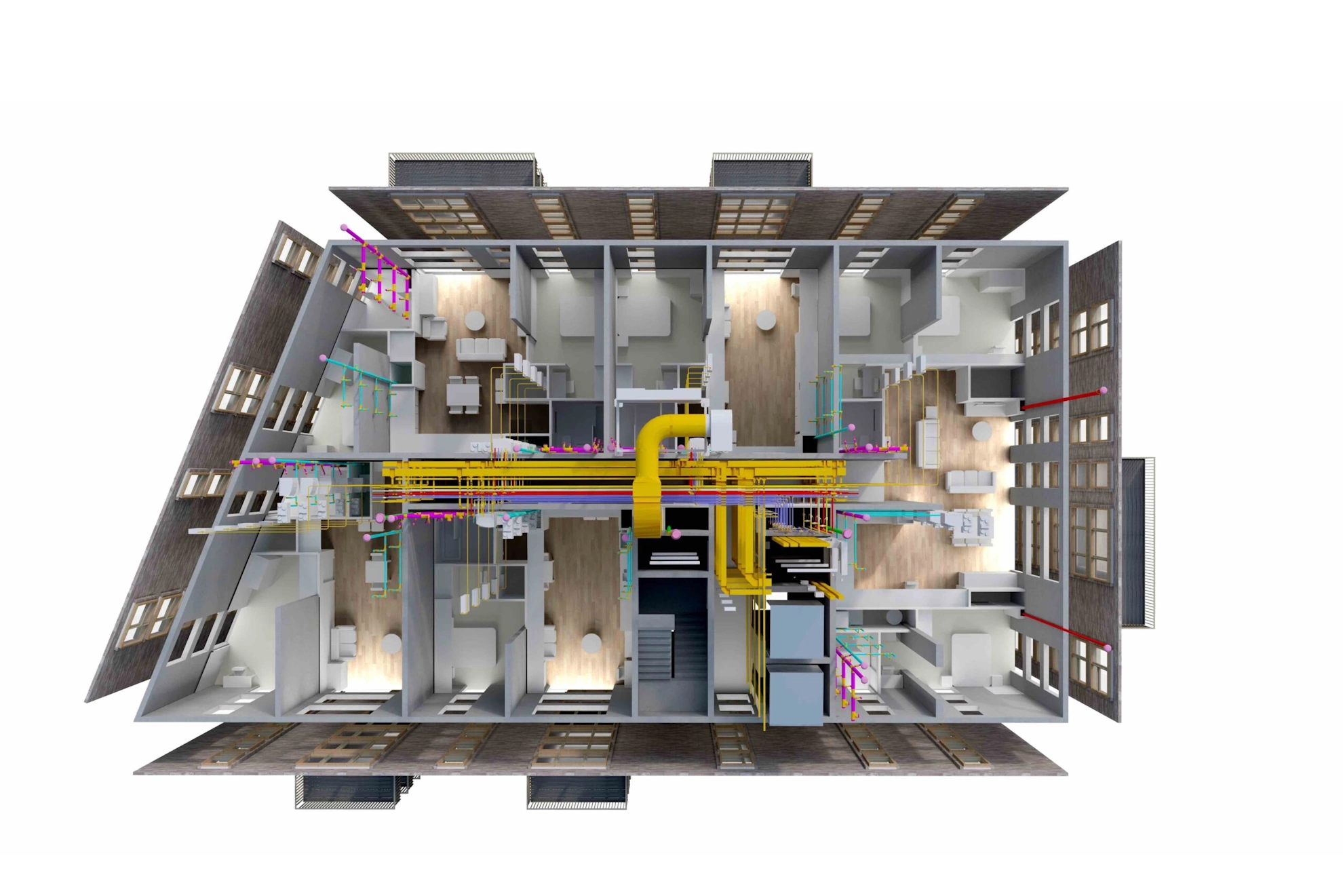
Expanding on the long-standing relationship with SWG, the Trust has begun the process of digitising its estate by laser scanning several smaller buildings to make use of the integrated BIM (building information modelling) capabilities within QFM, enabling the Trust to manage its building data and drive efficiencies across the real-estate portfolio more accurately.
This integration will also be used within the Trust’s new Energy Centre, following its construction, and will allow Kettering to manage a state-of-the-art facility from one central platform. By digitising their real-estate portfolio and implementing BIM software, the Trust’s estate teams can optimise their everyday maintenance and operations strategy for both new and existing buildings
The creation of a digital twin positions NHS Kettering as a technology leader within NHS England. Not only does that mean the clinical staff function more efficiently, treat more patients, and provide a greater level of service overall but it can also be used as an example of best practice for other NHS estate teams on the use of BIM.
Payne outlines, “NHS England is now pushing for all new building projects to be delivered with BIM. For the older estates like ours, the use of this technology is critical for the upkeep and efficiency of the buildings, so expanding into this space is the obvious next step.”
Compliance assurance
Edward Payne, chief engineer at NHS Kettering, is responsible for managing the Trust’s facilities and
estates team. He has a deep understanding of how FM systems work after 25 years in the industry. After
reviewing the market, Payne determined that there were only three or four appropriate solutions available. NHS Kettering chose SWG due to QFM software’s ease of use, the functional capabilities that aligned with the requirements of NHS Trusts, and its ability to handle numerous and diverse FM tasks required across the estate. With a comprehensive understanding of the hospital’s technical and reporting standards, Payne and his team and his team were able to configure the data collection and analysis in such a way as to enable accurate reporting for ERIC, PAM, PLACE, and other key compliance.
Over the last decade, compliance standards for NHS estates have become increasingly stringent. The Premises Assurance Model (PAM) was introduced to help NHS estate managers make more informed decisions about the development of their facilities services and provide assurances that the estate is safe, efficient, and up to standard on quality.
Since its introduction in 2013, PAM has been regularly updated in line with policy changes and feedback from various user groups. As a result, it can be challenging to keep up to date with PAM changes if you are operating with an older estate. The use of QFM has made this process considerably smoother for Kettering. The software is kept updated in line with relevant governmental guidance and compliance strategies for asset data, which matches the requirements of PAM and can be integrated with the relevant PPM schedules. This ensures that Kettering can produce accurate and correct reporting to the NHS England body when necessary.
PPM and reactive maintenance schedules
PPM is where Kettering’s work with SWG has been transformational. Keeping healthcare assets in working order is essential for a hospital to operate efficiently and treat all its patients promptly. If these assets suddenly fail and are inoperable for an uncertain period, it can impact appointments and waitlists for months. By having an effective PPM schedule, hospitals can minimise the potential downtime of such assets and drive better cost efficiencies.
QFM has enabled the Kettering Estates team to align more closely with SFG20 recommendations, steadily increasing the number of PPM events generated by double. This has made maintenance far more efficient by allowing the estates team to schedule and allocate resources dynamically rather than have engineers spend extra time traveling around the site. Initially, reactive works totalled approximately 1,500 a month. By analysing and performing repeat works, this has now reduced to less than 1,200 a month.
Simultaneously, PPM works have increased from around 1,200 a month to 1,700. The Trust is becoming more proactive, thus reducing time of non-availability and service interruptions. It wasn’t uncommon to force cancellations of clinics or theatre due to estate service failures. The Trust have had no unplanned / unmanageable interruptions for over 12 months.
Payne describes: “Using technology to take on more of the reporting work frees up more time for patient care, which is always our number one priority. The use of the resource helps to improve productivity. For example, porters can check jobs on-the-go rather than report back after every job, saving time and increasing the number of patients being moved to where they need to be.”
A well-managed PPM schedule also helps facilities managers to keep up with other aspects of compliance. For Kettering, keeping up with Health Technical Memoranda (HTM) documents from NHS England is critical. They advise on the design, installation, and operation of specialised building and engineering technology used in the delivery of healthcare and healthcare-specific elements of standards and best practices. By including HTM guidelines within the schedules, the work of the estates team will always be within the correct parameters set by NHS England and can be evidenced through reporting. SFG20 integration is also vital for Kettering in managing maintenance across the Trust’s estate. Within QFM, all PPM schedules are aligned with the SFG20 industry-standard specifications. This way, when a new HTM is created, and SFG20 updates its schedules, the Trust’s PPM schedules are always aligned with the current compliance regulations.
Reporting
Gathering building information from the official NHS England figures and internal reporting procedures can take a long time, which can create backlogs across the hospital. With QFM, Kettering NHS can access real-time data about a building. This can include clinical and nonclinical data, space utilisation data, and room availability.
Using QFM has provided the hospital with far greater visibility of the hospital’s asset and maintenance data. Two months after implementing the software, Kettering was able to identify and take steps toward rectifying areas that were causing more engineer visits.
The subsequent reduction engineer travel time and visits, including the costs incurred when issues arise out of hours, has led to a drop from an average of 40 calls a week to around 10, saving the hospital between £2,000- £4,000 per week.
QFM is also integrated with Microsoft Power BI. The live data highlights the daily status of the hospital’s assets and equipment.
Payne explains: “We didn’t know how we were performing before with real accuracy. Now we can visualise it all, helping us to identify poor performing areas and implement the right steps to fix them. This data is also shared among the NHS groups that Kettering is linked to, including Leicester and Northampton NHS sites. This level of live reporting helps the estates function efficiently, enables clinical staff to see more patients, and ensures an optimum level of service.”
What’s more, QFM Space provides a mechanism for Kettering NHS to manage and submit data for annual ERIC reporting, breaking down the key information relating to the costs of providing, maintaining and servicing the NHS estate. Using QFM Space data has enabled the Trust to make quicker decisions on space utilisation. Whereas previously the team would have had to visit an area, it now can perform a desktop feasibility and determine the suitability of areas to accommodate clinical services.
This has been extremely useful recently with the challenges of relocation due to the nationally recognised issue with buildings containing RAAC.
Future focus
The use of QFM has already brought a wealth of benefits to Kettering and the functionality of its estate. By starting small and developing the offering over time, SWG and the Trust have been able to create a building system that caters to the specific needs of a diverse NHS estate.
Payne describes, “There has always been a need for tracking the work carried out on-site and we have been using electronic systems for more than 25 year. But new technologies, compliance regulations and health and safety procedures meant we needed a more robust system. QFM was that system, and it has already bought us a wealth of benefits.”
SWG are working with the Trust to integrate housekeeping and portering systems into QFM so that they are further aligned and to help the estate teams with their activity scheduling. Once this integration is complete, it will create additional efficiencies for the teams as information about room schedules and maintenance work will be accessible to all the relevant individuals from one central location.
This step will improve the productivity of the porters who can prioritise work that requires the most attention by viewing all open jobs from one central system. By improving the productivity levels of the cleaning teams by just two per cent, the licence fee cost is recouped through the cost savings generated, so the investment will continue to create financial and operational benefits for the estate.
“We have been making the case for QFM for years, and the development journey we have gone on with SWG has been positive from the very start. I cannot urge other NHS Foundation Trust leaders enough to begin their journey with this technology.” Payne continues, “The benefits of QFM are second to none, having totally transformed the way we work at Kettering General Hospital for the better.”


